


France is about the size of Texas, which is of course a very American way to view the country. It’s also an incomplete one: What we call “France” is only a certain portion of the territory around the world (and I do mean all around the world) that the French government controls.
Thankfully, for the purposes of this article, we will only be looking at that portion, i.e. what we call France, known officially as Metropolitan France. But more on that in a minute.
Specifically, I’ll be breaking down the regions of France. And not for the sake of a geography lesson, but rather so that you can make sense of them as you put your own trip together.
Why Understanding France’s Regions is Confusing to Travelers
If you ever studied European history—or, perhaps more accurately, if you paid attention during European history courses—then you’ll realize how incredibly complex France’s geographical and political histories are. The country has gone from being a kingdom to an empire to a republic; it has at turns had provinces and prefectures and departments, which if you’re American are words that have somewhere between no meaning and very little meaning.
Beyond the historical context, there’s the reality that within contemporary tourism, travelers tend to use city names to refer to some areas of France, colloquial terms for others and actual region names for still others. For instance, while most people correctly refer to western France are being composed of Brittany and Normandy, many use the city name “Bordeaux” as a catch-all for southwestern France (which is actually Nouvelle Aquitaine). Likewise, although Provence, the French Alps and the Côte d’Azur seem like separate regions to tourists, they’re part of the same official region.
How to Make Sense of France’s Regions
Understand the “official” map
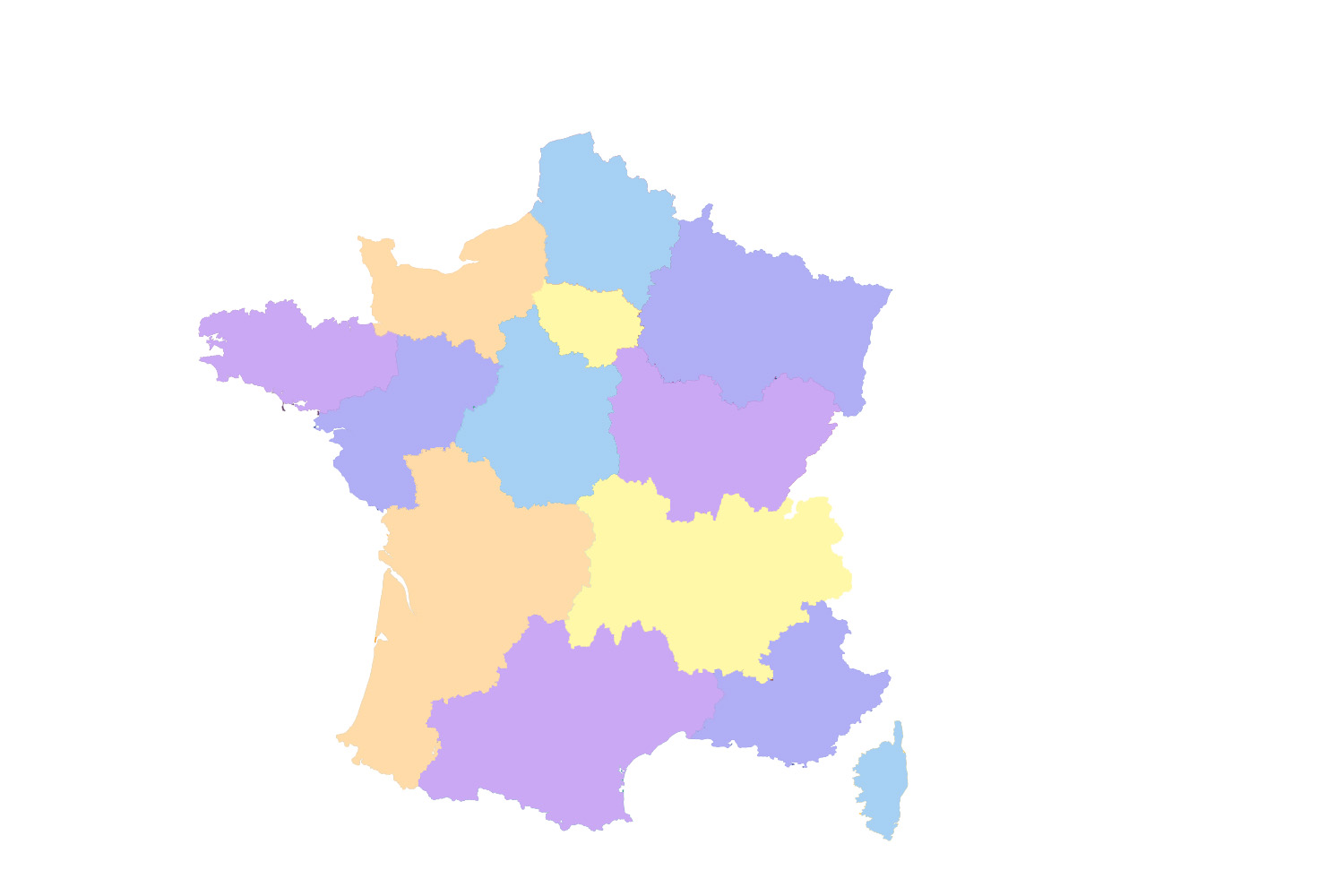
Officially, Metropolitan France (so, mainland European France plus Corsica) has 13 regions, which are labeled on the map below. These include names you’ll probably recognize (such as Brittany and Normandy) and ones you might not, such as “Grand Est” or “Occitanie.” If you can, I’d suggest doing your best to memorize this map before you travel.
(But take note of colloquial customs)
Indeed, far from official French regions being the only…conventional naming convenient, many people don’t respect them at all. For example, city names like Paris and Bordeaux tend to be used interchangeably with the regions they’re in (Île-de-France and Nouvelle Aquitaine, respectively). Likewise, many people use “Côte d’Azur” to refer to France’s entire coastline, when it really just describe the stretch between about Saint-Tropez and Menton.
Dispense with the idea of provinces
Many travelers who come from countries with states simply presume that other places use provinces in their stead, and that in order to understand the local geography, they need to learn the names and locations of these provinces. In France’s case, however, provinces ceased to exist over two centuries ago—they are as irrelevant to life today as Napoleon or Marie Antoinette.
(And don’t bother with “departments”)
Now that we’ve answered the question “does France have states or provinces?,” we can move onto departments, which are smaller administrative regions within the regions. Or rather, we can’t move onto them, because they are frankly irrelevant for most travelers. Instead, they are mostly important if you are a French bureaucrat, or potentially if you have a deep interest in French geography apart from its utility to travelers.
Make sense of the country in terms of your trip
At the end of the day, to be sure, you aren’t taking any kind of exam—you need to learn how France is divided and categorize in order to make sense of your trip, and potentially be able to describe it to other people. Is it correct to say that “Bordeaux” can describe everything from the wineries of Margaux and Saint-Emilion, to the French Basque Country, to the port of La Rochelle? No. But if that’s how you can keep your travels integrated in your mind, then more power to you.

What About “Overseas France”?
I don’t write much about Overseas France on this website, and for a very simple reason: I’m still busy trying to see everywhere in Metropolitan France. Confusingly, depending upon who you ask, it’s perfectly acceptable to consider this all—so all of France besides the regions on the European mainland, plus Corsica—as one region. Which again, for the purposes of this website (at least as I’m writing this, in the late 2020s), is purposely valid.
Like understanding of the French territories themselves, at least in a travel context, this makes sense. People don’t generally go to Cayenne or Tahiti, for example, and tell their friends that they will soon be traveling to “France.” And so while I do hope to visit many of these places in the not-too-distance future, I don’t think they’re relevant to a discussion about French regions as far as this website is concerned.
Other FAQ About the Regions of France
What are the 13 regions of France called?
Moving from west to east and then from north to south, the 13 French regions are also follows: Brittany; Normandy; Hautes-de-France; Grand Est; Pays de la Loire; Centre Val de Loire; Île-de-France; Bourgogne Franche-Comté; Nouvelle Aquitaine; Auvergne Rhône-Alps; Occitanie; Provence-Alpes-Côte d’Azur; and Corsica.
What is the nicest region of France?
Personally, I find that the most rewarding region of France for travelers is Provence-Alpes-Côte d’Azur. As its name suggests, you get the relaxed agricultural region of Provence, the dramatic mountain peaks of the French Alps and the legendary beaches of the Côte d’Azur all within a relatively small and eminently explorable region.
What does the term “Metropolitan France” mean?
In simple terms, “Metropolitan France” refers to the 12 regions of France on the European mainland, plus the island of Corsica. It does not include outlying territories like French Polynesia or French Guiana, which are collectively referred to as “Overseas France.”

The Bottom Line
I hope you’ve now got a better grasp of the regions of France—and not just for geography’s sake. With your new battery of knowledge, you can speak of your travels not just in terms of cities (like Nice and Bordeaux), but of the regions they belong to. Indeed, knowing France’s regions (since there are only 13, at least in Metropolitan France) can help make the vast array of destinations and experiences in France seem slightly less unruly. This is especially helpful if you’re returning to France for a more in-depth trip after just exploring Paris and some of the country’s more fundamental reaches. Need personalized help assembling your France itinerary? Consider hiring me to help!